


Russian President Vladimir Putin delivers a speech during an extended meeting of the Russian Defense Ministry Council at the National Defense Control Center in Moscow on Wednesday.
Vadim Savitsky/Sputnik/AFP via Getty Images
hide caption
toggle caption
Vadim Savitsky/Sputnik/AFP via Getty Images
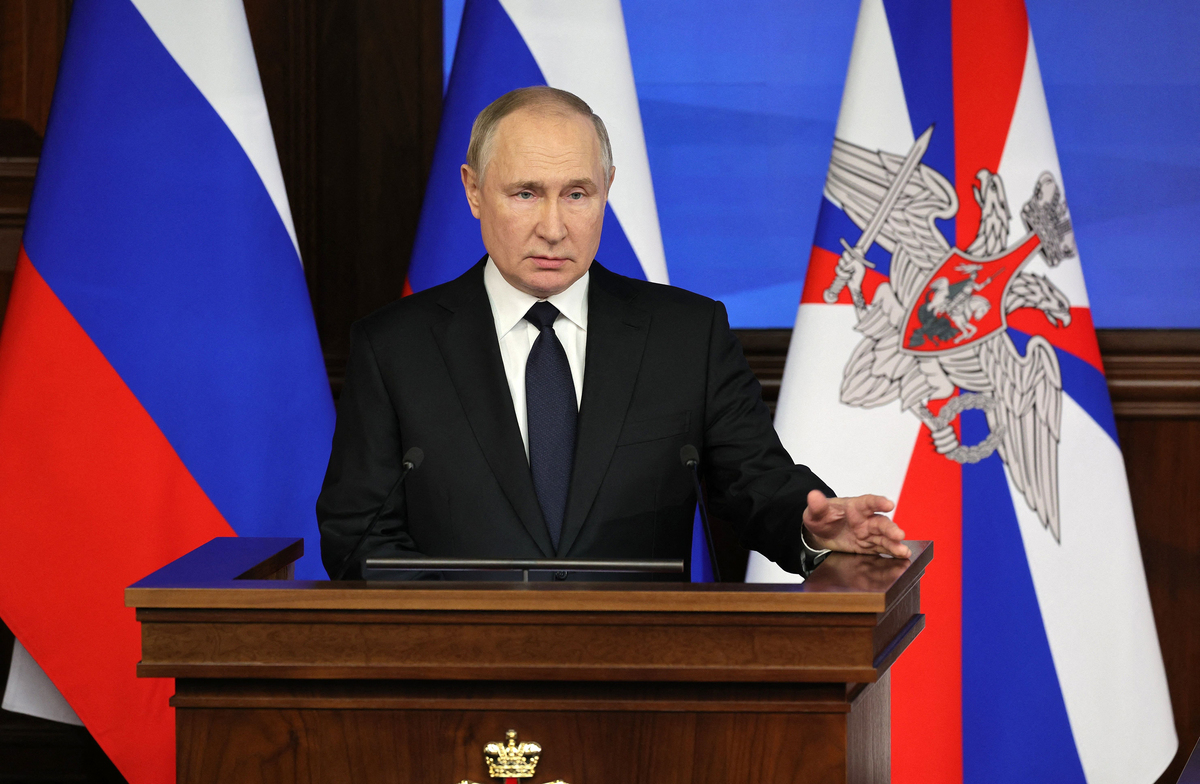
Russian President Vladimir Putin delivers a speech during an extended meeting of the Russian Defense Ministry Council at the National Defense Control Center in Moscow on Wednesday.
Vadim Savitsky/Sputnik/AFP via Getty Images
Over the past year, the United States and many of its allies have imposed a massive level of sanctions on Russia for its invasion of Ukraine.
Prominent Russians, including oligarchs and officials close to Russian President Vladimir Putin, as well as the country’s banking, energy and manufacturing sectors and access to global trade were all targeted.
Yet, despite the sanctions — seen as unprecedented in terms of reach, speed and coordination — the Russian economy is still functioning and the Kremlin is still waging war on Ukraine. This has led to questions about whether the sanctions are effective. Even though they may not have created the kind of economic growth unrest in Russia originally plannedanalysts say these measures are causing damage and could have a deeper impact in the future.

“The short answer is yes” – sanctions work, says Edward Fishman, who led the State Department’s sanctions policy after Russia’s 2014 invasion of Crimea. But he says it depends on what that Western nations are aiming for with the measures.
“They’re not trying to get a psychological change in Putin. They’re not trying to make Putin, you know, wake up in the morning and decide that Ukraine isn’t worth it… effort,” he said. “What they’re really trying to do is just create attrition in Russia’s military-industrial complex and its wider economy.”
Shutting down Russian banks

A demonstrator holds a sign during a rally against Russia’s invasion of Ukraine, Place de la République in Paris, February 2, 2020. 26.
Geoffroy Van Der Hasselt/AFP via Getty Images
hide caption
toggle caption
Geoffroy Van Der Hasselt/AFP via Getty Images
the The United States, Canada and affected European countries Russia is tough with financial sanctions shortly after its invasion of Ukraine in late February. They cut off a number of Russia’s biggest banks from the SWIFT system, a messaging service that connects financial institutions around the world. Several banks were later subject to total blocking sanctions.
“I think that in my time the idea of imposing blocking sanctions on Sberbank, which is by far the largest bank in Russia, was unthinkable, not to mention sanctions on the Central Bank of Russia,” says Fishman today a scholar at Center on Global Energy Policy at Columbia University. He thinks the moves probably surprised Putin.
Sanctioning the Central Bank of Russia froze almost half of its more than 630 billion dollars in foreign exchange reserves. Economists thought the Russian economy would collapse.
Moscow has established financial strength
But Elina Ribakova, an economist at the Institute of International Finance (IIF) in Washington, says the central bank has spent years putting policies in place to defend its financial system against this kind of scenario. She says Russia has used excess energy revenue to build a “special piggy bank”.
The strategy, which analysts dubbed “Fortress Russia”, aimed to make Russia’s economy sanction-proof – but few economists believed it would work.
“This Russian fortress strategy, which was talked about and some laughed at at the start of the 2022 sanctions, has proven to be at least partially effective,” she says. “We expected a much deeper contraction, myself included.”
Ribakova says preparedness, along with a competent response from central bank officials, helped control the immediate financial sanctions crisis, allowing Russia to retain more than $250 billion in foreign exchange reserves.
Yet the International Monetary Fund estimates The Russian economy will contract by 3.4% this year, instead of growing by about as much in 2022 as predicted before the war.
Maria Demertzis, senior researcher at Bruegel, a Brussels-based economic think tank, says there would likely be a bigger drop if it weren’t for oil and natural gas sales, which account for around half of the government budget.
“Also considering the incredible increase in the price of gas, especially gas, and oil, the income of the Russian authorities and the Russian coffers has been exorbitant,” she says. And this, of course, allowed the Russian economy to continue to function.

But the outlook for Russian oil and gas revenues may soon change. In September, Putin shut off most natural gas flows to Europe, Russia’s leading customer. And there is a new European Union ban on most Russian oil importsas well as a cap on Russian oil prices.
Oil imports into China, India and Turkey help offset some of the impending loss, but they are paying reduced prices for Russian oil.

A petrol station is seen July 29 in Moscow, Russia.
Alexander Nemenov/AFP via Getty Images
hide caption
toggle caption
Alexander Nemenov/AFP via Getty Images
Russia is witnessing a corporate flight
Meanwhile, Russians are seeing their modern economy suffer tangible setbacks. More than 1,000 international companies have ceased operations or pulled out of Russia altogether, study finds by the Yale School of Management. Runaway companies take with them capital investment, technology and expertise.
Imports of Western-made components have plummeted, impacting manufacturing, in particular. Columbia’s Fishman says the country’s major rail and auto sectors have seen production halve, also leaving Russian consumers with lower-quality products.
“Moscow had to relax the rules to allow domestic cars to be made without airbags or anti-lock brakes because they cannot source components domestically,” he said. “Before, they bought them in Europe and the United States, and they can’t do that anymore.”
Russia is also struggling to get western-made products semiconductors, which IIR’s Ribakova says are essential for many industries, from agriculture to aviation. “Even in the military, Russia depends on foreign-produced chips, for example, and other types of technology,” she says. “He needs it to keep waging war.”
Russia is trying to establish alternative supply routes from countries like China, Turkey and Kazakhstan, but they cannot replace high-tech imports such as semiconductors.
Bruegel’s Demertzis says all sanctions will be a drag on Russia. She says the economy is in a terrible state, but Russia will survive.
“They won’t be wiped off the world map,” she says. “But it will be a much, much poorer country” in the future.
Comments
Post a Comment