
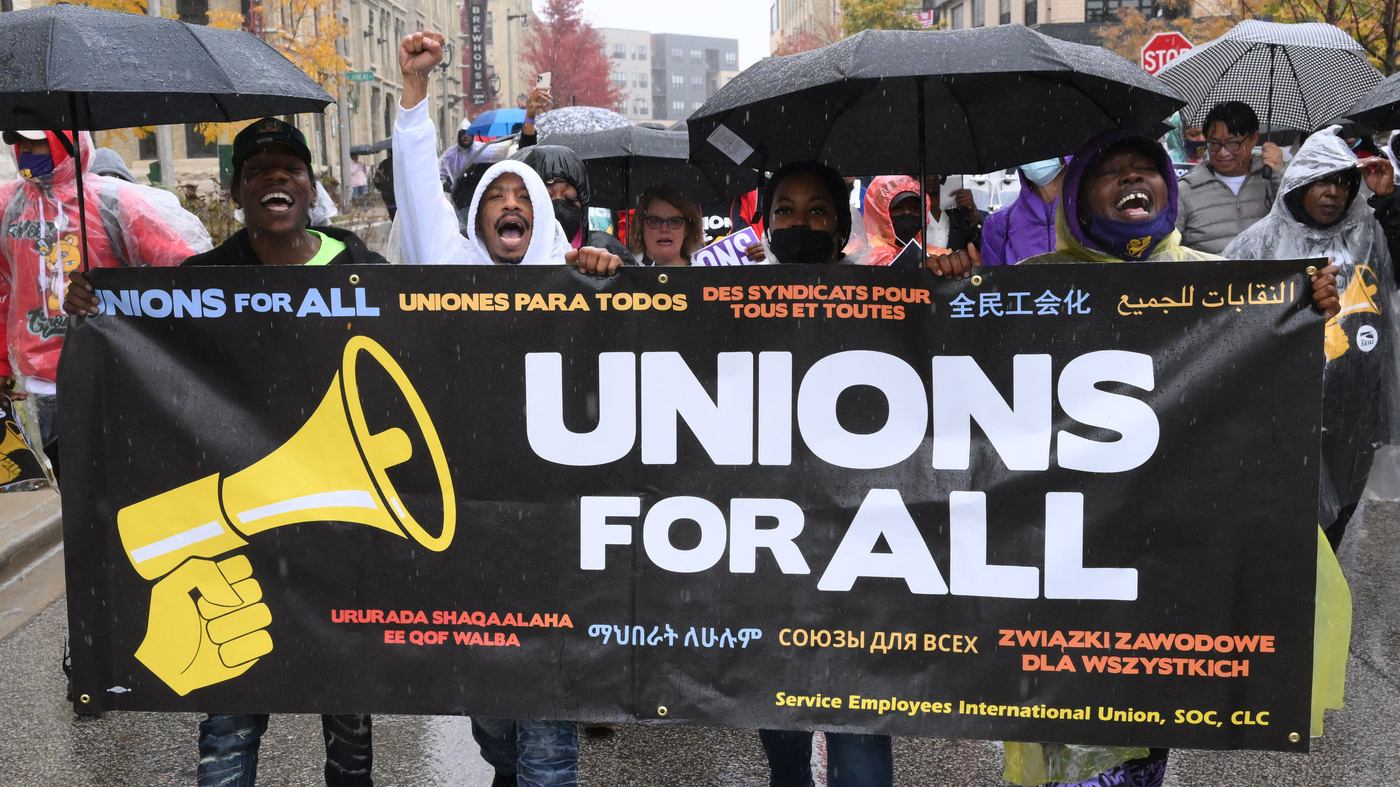

Milwaukee, Wisconsin workers take to the streets in Milwaukee, Wisconsin.
Daniel Boczarski/Getty Images for SEIU
hide caption
toggle caption
Daniel Boczarski/Getty Images for SEIU

Milwaukee, Wisconsin workers take to the streets in Milwaukee, Wisconsin.
Daniel Boczarski/Getty Images for SEIU
This year, a rare burst of union momentum has produced major victories – as well as major losses and fights with employers.
Starbucks and Amazon were far from Alone in the face of major union campaigns. While unemployment remained low and wages rose, workers in education and healthcare, restaurants and retail continued their pandemic-era campaign for higher wages, better sick leave and other changes to their working conditions. But tangible results are hard to quantify – until now. 2023 could tell us much more about the durability and influence of the resurgent labor movement.
Here’s some of what happened this year.
1. The number of union elections has skyrocketed in 2022 – and unions have won most of them.
According to the National Labor Relations Board, there were 1,249 union elections in fiscal year 2022, an increase of nearly 50% from the previous year.
Workers voted to unionize in 72% of these elections, up from 61% in 2021.
Several factors explain this increase. Public support for unions is at its highest level in 60 years (more details below). And Starbucks played an outsized role driving up to that number. Starbucks has represented about a quarter of all union elections this year, and the union has won four out of five elections.

This year, unions were formed in workplaces that had never or rarely seen unionization. Workers voted to unionize for the first time at Trader Joe’s, Apple and Chipotle stores. The historic union victory at a huge Amazon warehouse in Staten Island is still contested by the company.
Other notable labor campaigns this year have involved graduate students at the Massachusetts Institute of Technology, health care workers at Kaiser Permanente and elsewhere, and autoworkers at Ultium Cells, a cell factory for electric vehicle batteries owned by GM in Warren, Ohio.
2. Companies have mounted strong counter-campaigns, and some are working.
Companies often say that the union disrupts their direct relationship with workers. To deter employees from unionizing, they preemptively raised wages, added benefits, and made changes to the workplace. They also flooded stores with managers and, in some cases, fired pro-union workers citing other unrelated violations.
It all seems to work. Amazon workers at other warehouses voted against unionization. So did workers at a Home Depot and a Trader Joe location. Momentum has slowed at Starbuckswhere approximately 270 unionized locations represent less than 3% of all company-operated stores in the United States

Amazon Union President Chris Smalls speaks during a protest outside an event in New York with Amazon CEO Andy Jassy. The independent ALU won a union election at a Staten Island warehouse in April, but was unable to win any other union elections.
Spencer Platt/Getty Images
hide caption
toggle caption
Spencer Platt/Getty Images

Amazon Union President Chris Smalls speaks during a protest outside an event in New York with Amazon CEO Andy Jassy. The independent ALU won a union election at a Staten Island warehouse in April, but was unable to win any other union elections.
Spencer Platt/Getty Images
This year, federal labor officials have stepped up legal challenges, accusing top employers — including Amazon and Starbucks — of unfair labor practices (which the companies deny). Federal law prohibits employers from retaliating against union activity or even questioning an employee about union activity. Still, companies have lengthy legal avenues to contest any related charges.
3. Most of these union victories have yet to result in collective agreements
Despite all the important union victories in 2022, it is a very slow process to reach a collective bargaining contract to negotiate wage increases or other changes that union workers want.
At Amazon’s Staten Island warehouse, the process hasn’t even begun – as Amazon Labor Union victory remains disputedeven after a hearing of several months.

San Francisco International Airport catering workers carry signs as they strike outside an airport terminal on September 26, 2022 in San Francisco, California.
Justin Sullivan/Getty Images
hide caption
toggle caption
Justin Sullivan/Getty Images
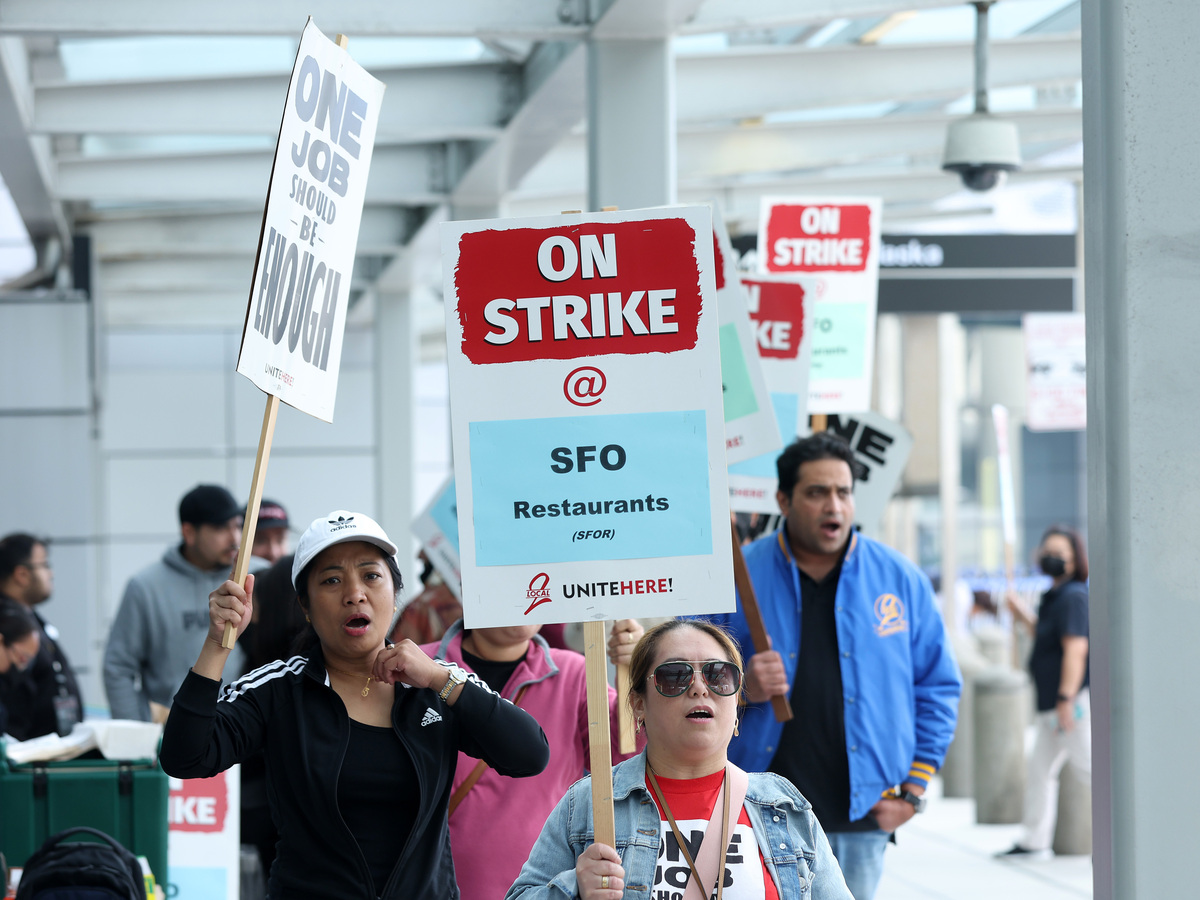
San Francisco International Airport catering workers carry signs as they strike outside an airport terminal on September 26, 2022 in San Francisco, California.
Justin Sullivan/Getty Images
At Starbucks, negotiations have been constantly disrupted, with workers accusing the company of delaying tactics designed to discourage unionization, while the company accuses the union of illegally taping and broadcasting bargaining sessions. Each side blamed the other for failing to negotiate in good faith.
4. Some unionized workers got big raises, even keeping up with inflation.
Overall, salaries have increased this year by 5.1% compared to last year. With many more openings than available workers, wages have risen even faster in some of the lowest paying jobs. But taking into account inflation of 7%, overall wages have actually gone downand many workers felt they were losing ground.

Some unions have been able to get more from employers, successfully negotiating increases that match or even beat inflation this year.
The railwaymen did not understand everything they wanted to get out of Prolonged talks with freight railwaysbut they secured a 7% raise in 2022, with pledges of another 8.5% over the next two years, plus cash bonuses each year.
Food service workers at San Francisco International Airport won a 30% pay rise over two years after going on strike for three days in September. They will see their wages rise from around $17 an hour to $22 an hour by 2024. The deal also included health insurance, a pension and a one-time bonus.
5. Americans approve of unions at levels not seen since the 1960s – but next year’s economy looms on the horizon
Only about 10% of American workers belong to a unionbut 68% of Americans approve of unions, according to Gallup. This is a level of support not seen since 1965.
Animated trade union campaigns in cafes, on college campuses and at companies such as Starbucks and REI that have long positioned themselves as progressive have brought a new generation of workers into the fold of work. Their decision to stay will likely depend on their career prospects in other fields. and how they fare in collective bargaining.

The economy is another factor. Economists say it is uncertain whether a recession – if it occurs – would stifle union enthusiasm. Sometimes when things look down on workers, they may feel like they need a union to represent their interests. Historically, however, an economic downturn is a tough time for organizing and campaigning for better wages and benefits.
Comments
Post a Comment